
Functional Medicine Patient Retention: Why a Clinical Roadmap Outperforms Fee-for-Service
July 16, 2026
Many functional medicine practitioners assume that when patients stop caring after two or three visits, the problem is non-compliance, financial limitations, or a lack of commitment.
In reality, those may only be symptoms.
A more common issue is that patients never fully understood the journey ahead.
When every follow-up appointment, supplement recommendation, laboratory test, and treatment adjustment feels like another separate purchase, patients begin evaluating every decision independently. Instead of focusing on healing, they start asking themselves:
- Do I really need another visit?
- Can I skip these supplements?
- Should I buy them online instead?
- Is this treatment actually working?
This constant cycle creates decision fatigue. Eventually, many patients disengage – not because they don’t value your expertise, but because they lack confidence in the overall process.
A structured clinical roadmap changes that experience completely.
Rather than selling appointments one at a time, you’re guiding patients through a clearly defined system designed to achieve a specific health outcome. Patients understand where they are, where they’re going, what comes next, and why each phase matters.
That clarity improves trust, increases adherence, strengthens retention, and often produces better clinical outcomes.
In this article, we’ll explore why traditional fee-for-service models frequently undermine functional medicine practices and how implementing a structured clinical roadmap can benefit both your patients and your business.
Table of Contents
- Why Patients Leave Too Early
- The Hidden Problem with Fee-for-Service Care
- Why Functional Medicine Requires a Different Business Model
- The Psychology Behind Patient Commitment
- What Is a Clinical Roadmap?
- Why Clear Expectations Improve Outcomes
- Building Trust Through Structure
- Key Takeaways
Why Patients Leave After Only a Few Visits
Most practitioners assume patients discontinue care because of:
- Cost
- Time
- Motivation
- Lack of discipline
While these factors certainly play a role, they often aren’t the primary reason.
In many cases, patients simply don’t understand the full treatment journey.
Imagine this experience from a patient’s perspective:
- Initial consultation
- Recommended laboratory testing
- Supplement purchases
- Follow-up appointment
- Additional supplements
- More testing
- Another follow-up
Each interaction feels like a separate financial decision.
Instead of viewing treatment as one comprehensive process, patients experience it as a series of individual transactions.
Eventually, they begin questioning every recommendation.
This uncertainty creates hesitation, and hesitation leads to missed appointments, reduced supplement adherence, delayed follow-ups, and premature discontinuation of care.
Clinical Insight
Patients rarely abandon treatment because they dislike structure.
More often, they leave because no structure was clearly presented.
The Hidden Cost of the Fee-for-Service Model
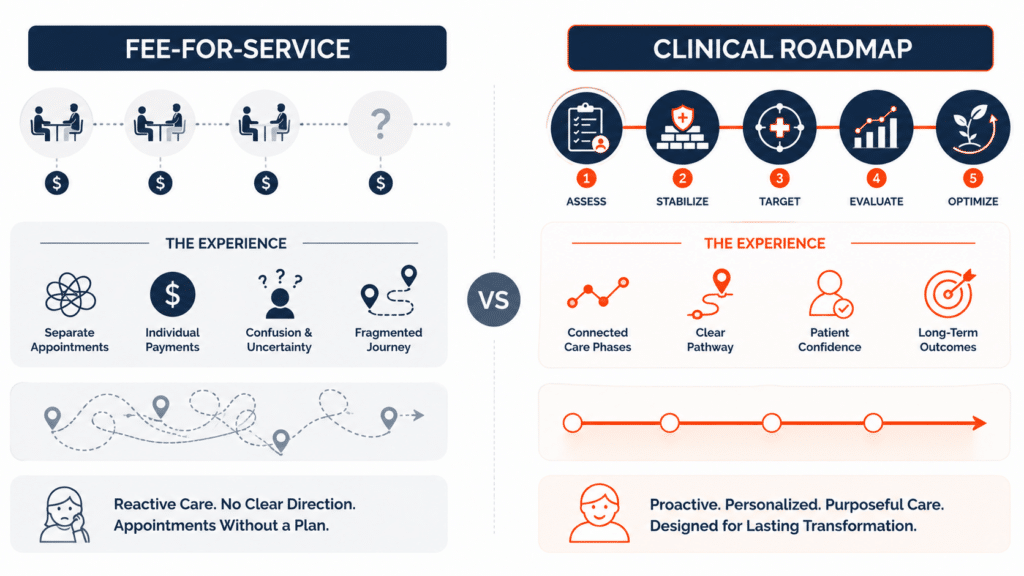
Traditional healthcare has conditioned patients to think in terms of individual appointments.
- Visit.
- Pay.
- Leave.
- Repeat when necessary.
That model works reasonably well for acute care.
Functional medicine is fundamentally different.
Addressing chronic health concerns often requires:
- Multiple clinical visits
- Lifestyle modifications
- Laboratory interpretation
- Nutritional interventions
- Supplement protocols
- Ongoing reassessment
- Progressive treatment phases
These components work together.
Unfortunately, charging separately for every element unintentionally reinforces the perception that each recommendation is optional.
Patients begin making financial decisions instead of clinical decisions.
Transactional Thinking vs Clinical Commitment
| Fee-for-Service | Clinical Roadmap |
| Individual purchases | Complete care journey |
| Repeated financial decisions | Single commitment |
| Unclear next steps | Defined treatment phases |
| Higher cancellation risk | Greater adherence |
| Lower retention | Higher completion rates |
When patients perceive treatment as an integrated process rather than isolated services, they are significantly more likely to remain engaged.
Functional Medicine Is a Process, Not an Appointment
One of the defining characteristics of functional medicine is that practitioners investigate underlying dysfunction instead of merely suppressing symptoms.
Rather than asking:
“Which medication treats this symptom?”
Functional medicine asks:
- Why is this symptom occurring?
- Which systems are underperforming?
- What are the primary stressors?
- Which physiological imbalances should be addressed first?
- What sequence of interventions will produce the greatest improvement?
Those questions cannot be answered—or resolved—in a single visit.
They require an organized clinical strategy.
This is why successful practitioners often follow repeatable treatment frameworks, even while individualizing care for each patient.
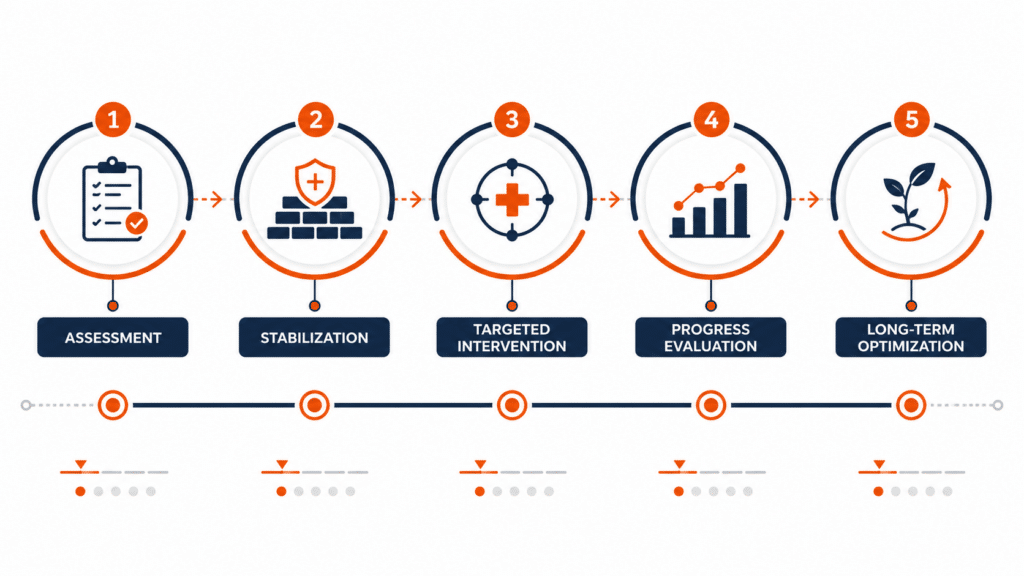
Although protocols may vary, many practices naturally move through similar stages:
- Assessment
- Stabilization
- Foundational support
- Targeted intervention
- Reassessment
- Optimization
- Long-term maintenance
Patients don’t necessarily need every clinical detail.
They simply need confidence that there is a logical path forward.
Why Patients Want a Roadmap
One of the most overlooked aspects of patient communication is certainty.
Patients don’t expect guarantees.
They do expect direction.
Most patients want answers to questions such as:
- What happens first?
- How long will this take?
- What results should I expect?
- When will we reassess?
- How will we measure progress?
- What happens if treatment needs to change?
When these questions remain unanswered, uncertainty increases.
When uncertainty increases, commitment decreases.
A clearly presented roadmap transforms uncertainty into confidence.
Instead of wondering whether another appointment is necessary, patients understand that each phase serves a specific purpose within the broader treatment strategy.
That shift changes the entire patient experience.
Key Takeaways
- Patient retention problems often stem from poor treatment clarity rather than poor patient motivation.
- Functional medicine naturally lends itself to structured treatment journeys instead of isolated appointments.
- Every separate financial decision increases the likelihood of patient dropout.
- A clinical roadmap provides clarity, confidence, and stronger long-term engagement.
- Patients commit more readily when they understand the destination—not just the next appointment.
How a Clinical Roadmap Changes the Patient Experience
A clinical roadmap isn’t simply a packaged service or a collection of appointments. It’s a structured care journey that helps patients understand how they’ll move from their current health challenges toward a clearly defined outcome.
Patients don’t just want recommendations – they want confidence that there’s a thoughtful plan behind those recommendations.
When practitioners explain treatment as a phased process rather than a series of disconnected visits, patients are more likely to:
- Commit to care
- Attend scheduled follow-ups
- Follow supplement protocols
- Complete recommended testing
- Stay engaged until meaningful outcomes are achieved
Instead of making a financial decision at every appointment, patients make one informed decision to commit to a structured process.
What Every Clinical Roadmap Should Include
While every practice has its own methodology, the most effective roadmaps share several core elements.
1. A Clearly Defined Outcome
Patients buy outcomes – not appointments.
For example, instead of saying:
“We’ll monitor your progress over the next few months.”
Frame the conversation around the transformation:
- Improve digestive function
- Restore energy levels
- Reduce inflammatory symptoms
- Improve sleep quality
- Support thyroid health
- Improve metabolic resilience
The outcome should reflect the patient’s primary concern while remaining realistic and clinically appropriate.
2. A Defined Timeline
One of the biggest causes of patient uncertainty is not knowing how long treatment may take.
Even when timelines vary between individuals, providing an estimated framework helps patients mentally prepare for the journey.
Examples include:
- 6-week reset
- 8-week metabolic restoration
- 12-week gut health program
- 16-week hormone optimization framework
The timeline isn’t a guarantee of results—it’s a structure for delivering care.
3. Phased Treatment
Breaking care into stages makes complex treatment plans easier to understand.
Example Structure
| Phase | Primary Goal |
| Phase 1 | Comprehensive assessment and stabilization |
| Phase 2 | Address foundational physiological dysfunction |
| Phase 3 | Target underlying contributors |
| Phase 4 | Reassessment and optimization |
| Phase 5 | Long-term maintenance and prevention |
Patients appreciate knowing there is a logical progression rather than a collection of isolated recommendations.
4. Defined Follow-Up Schedule
Rather than asking patients to “come back when you’re ready,” establish follow-up appointments as part of the treatment journey.
This improves:
- Accountability
- Clinical monitoring
- Patient confidence
- Treatment adherence
It also eliminates uncertainty about when reassessment should occur.
5. Planned Progress Reviews
Patients need to see measurable progress.
Progress reviews may include:
- Symptom questionnaires
- Functional assessments
- Lifestyle reviews
- Laboratory reassessments
- Goal tracking
Visible progress reinforces commitment and helps patients recognize improvements they may otherwise overlook.
Why Patients Respond Better to Structured Care
Behavioral psychology suggests people are more likely to complete a process when they understand the path ahead.
A roadmap reduces uncertainty by answering questions before patients ask them.
Instead of wondering:
“Should I schedule another visit?”
Patients think:
“This is my next scheduled phase.”
That subtle shift dramatically changes patient behavior.
Reducing Decision Fatigue
Every separate purchase creates another opportunity for hesitation.

Patients begin asking:
- Do I really need this supplement?
- Can I delay my next appointment?
- Should I order somewhere cheaper?
- Is another lab test necessary?
Over time, these repeated decisions become mentally exhausting.
This is known as decision fatigue.
The more decisions patients must make, the less likely they are to remain consistent.
A structured roadmap minimizes unnecessary decision points and keeps patients focused on implementation rather than constant evaluation.
Why Supplement Compliance Improves
One of the most practical advantages of a structured care model is improved supplement adherence.
Many practitioners become frustrated when patients purchase products from online retailers or discontinue supplements prematurely.
However, this behavior is often a symptom of fragmented care—not simply price sensitivity.
When supplements are presented as an integrated part of a broader clinical strategy, patients perceive them differently.

Instead of seeing another purchase, they see another step in the treatment process.
Some practices further improve compliance by incorporating supplement allowances or credits into comprehensive care packages.
This approach can:
- Simplify purchasing decisions
- Improve adherence
- Reduce shopping around
- Increase convenience
- Create a more predictable patient experience
The objective isn’t to sell supplements – it’s to reduce friction that interrupts treatment.
Better Structure Leads to Better Outcomes
Clinical expertise alone doesn’t guarantee patient success.
Even excellent recommendations fail when patients discontinue care too early.
A structured roadmap encourages patients to remain engaged long enough to experience meaningful improvements.
This benefits both parties.
Patients receive:
- Better continuity of care
- Greater confidence
- Fewer interruptions
- Improved accountability
- More consistent support
Practitioners gain:
- Higher patient retention
- Better clinical outcomes
- More predictable scheduling
- Stronger patient relationships
- Improved practice stability
Everyone benefits when care continues through completion.
Common Concerns Practitioners Have
Many clinicians hesitate to implement structured care because they worry about flexibility.
Let’s address some of the most common concerns.
“Every Patient Is Different”
Absolutely.
Individualized care remains essential.
A roadmap doesn’t eliminate personalization – it provides structure around it.
Think of the roadmap as the framework, while clinical decisions remain customized within each phase.
“What If Treatment Changes?”
Treatment frequently changes.
New information emerges.
Laboratory results may reveal unexpected findings.
Patients encounter life events.
None of these situations invalidate the roadmap.
Instead, practitioners simply adjust the treatment strategy while continuing toward the same overall health objective.
Flexibility exists inside the framework.
“I Don’t Want to Sound Sales-Oriented”
This concern is common among healthcare professionals.
Fortunately, a roadmap isn’t about selling.
It’s about communicating.
Rather than persuading patients to purchase additional services, you’re explaining:
- What happens next
- Why it matters
- How each phase contributes to the overall outcome
Patients appreciate clarity.
They rarely object to organized care.
“What If Patients Don’t Get Results?”
No ethical practitioner can guarantee outcomes.
Health depends on many variables, including:
- Patient adherence
- Lifestyle
- Genetics
- Environmental factors
- Disease severity
Your responsibility is to provide a structured, evidence-informed process – not promises.
Clear communication about expectations builds trust while protecting professional integrity.
A Framework Creates Flexibility
At first glance, structure may seem restrictive.
In practice, the opposite is true.
When practitioners establish an organized framework, they gain greater flexibility because patients understand that adjustments are part of the process.
For example:
Instead of feeling pressured when treatment changes, you can confidently explain:
“Based on your progress, we’re going to modify Phase Two before moving into the next stage.”
Patients recognize this as refinement – not failure.
That mindset reduces anxiety and reinforces confidence in your clinical judgment.
Clinical Example
Imagine a patient seeking help for chronic fatigue, digestive complaints, and poor sleep.
Without a roadmap:
- Initial consultation
- Purchase supplements
- Follow-up visit
- Additional supplements
- More testing
- Delayed appointments
- Lost momentum
The patient begins questioning every recommendation independently.
Now imagine the same patient receiving a structured roadmap.
Week 1–2
- Comprehensive assessment
- Initial nutrition strategy
- Foundational supplements
Week 3–6
- Gut restoration
- Lifestyle optimization
- Stress management
Week 7–10
- Laboratory reassessment
- Protocol refinement
- Progress evaluation
Week 11–12
- Long-term maintenance
- Prevention strategy
- Future health planning
The clinical recommendations may be similar.
The difference lies in how the journey is communicated.
Expert Tips for Implementing a Clinical Roadmap

✓ Focus on outcomes rather than appointments.
✓ Explain why each phase matters.
✓ Set expectations during the first consultation.
✓ Schedule follow-ups in advance whenever appropriate.
✓ Measure progress consistently.
✓ Use visual treatment maps patients can reference at home.
✓ Revisit goals during every follow-up appointment.
✓ Reinforce that adjustments are part of personalized care – not signs that treatment has failed.
Key Takeaways
A successful functional medicine practice isn’t built on selling more appointments. It’s built on creating a clear, structured journey that helps patients stay committed long enough to achieve meaningful health outcomes.
When patients understand:
- where they are,
- where they’re going,
- why each step matters, and
- what success looks like,
they’re significantly more likely to remain engaged throughout their care.
That consistency supports stronger clinical results, higher patient satisfaction, and a healthier, more sustainable practice.
Conclusion
Many practitioners assume poor patient retention is simply part of running a functional medicine practice.
In reality, it often reflects how care is presented – not the quality of care itself.
A structured clinical roadmap transforms isolated appointments into a coordinated treatment experience.
Instead of repeatedly asking patients to decide whether the next visit, supplement, or laboratory test is worthwhile, you guide them through a clearly defined process focused on achieving measurable outcomes.
This shift reduces uncertainty, improves adherence, strengthens patient relationships, and creates a more predictable business model.
Most importantly, it gives patients the clarity and confidence they need to remain engaged until meaningful health improvements are achieved.

Next Steps
If you’re evaluating your current patient journey, ask yourself these questions:
- Where do patients most commonly disengage?
- Are your treatment phases clearly communicated?
- Do patients understand the expected timeline?
- Are follow-up appointments proactive or reactive?
- Does every recommendation connect to a larger clinical strategy?
Small improvements in communication and structure can dramatically improve both patient outcomes and practice performance.